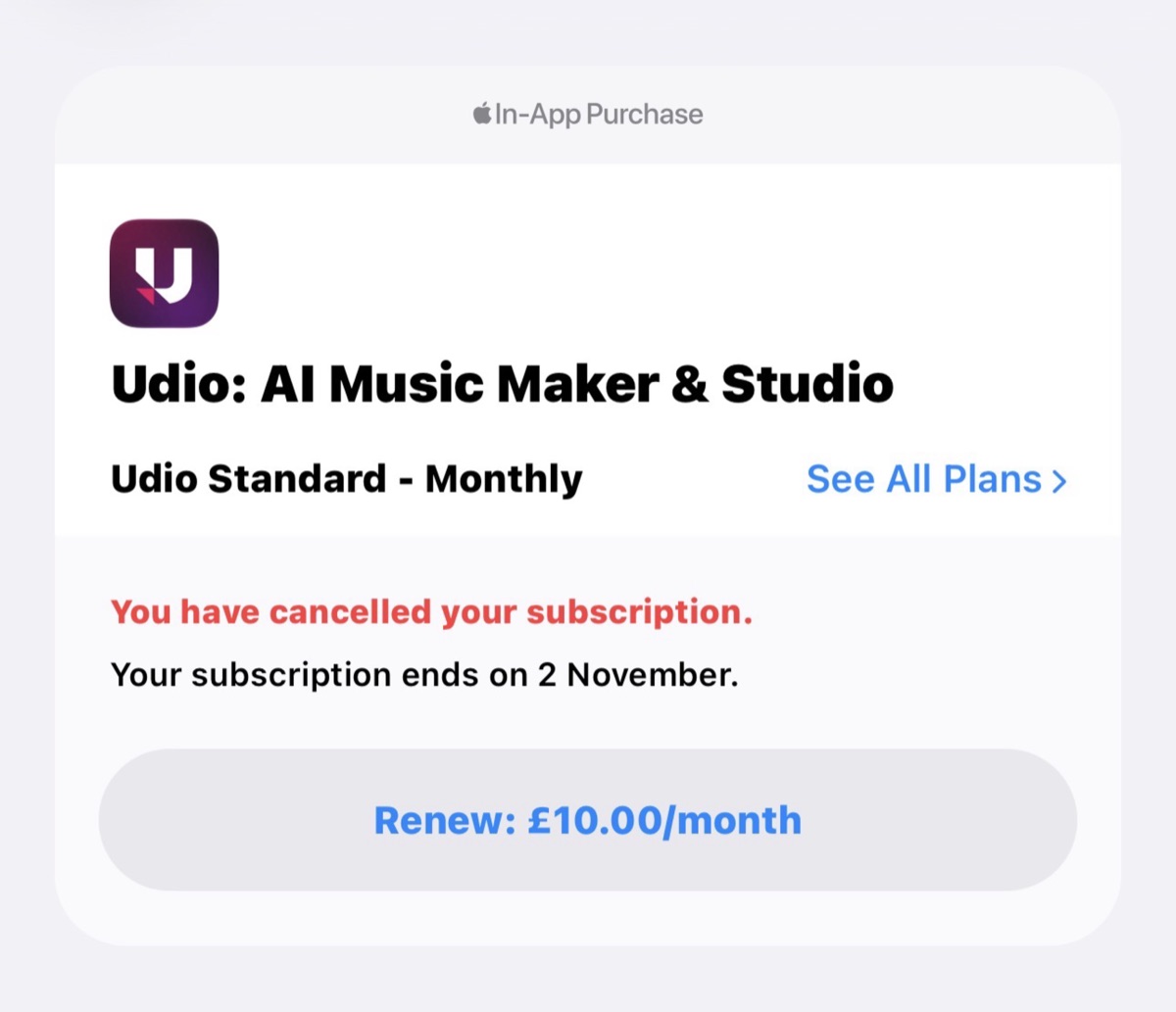
We cancelled our Udio subscription this week. If you pay for Udio to make music you want to sell, put out, or even open in a DAW, you should cancel yours too.

Udio has not shut down. You can still log in, generate songs and play them. What you cannot do, and have not been able to do for eleven months, is take a single one of them anywhere else.
Here is how it got there, what Suno and Mureka look like by comparison, and what it all means for anyone making AI music to sell.
Udio: still running, still locked
On 29 October 2025, Universal Music Group settled its copyright lawsuit against Udio. The two agreed to build a licensed AI music service together, due in 2026.
The next day Udio switched off downloads for everyone: audio, video and stems. After a backlash, it opened a single 48-hour window, from 3 to 5 November 2025, for people to get their existing songs out. Then the doors closed again.
Since then Udio has signed licensing deals with Warner Music Group (November 2025), Merlin (January 2026), Kobalt (April 2026) and Believe (April 2026). What it has not done is launch the licensed service, or turn downloads back on. At the end of September 2026, the service promised for 2026 still was not live, and Udio's only commitment on downloads was that it hopes to bring back some form of them after launch, with no date.
The model it is building towards is what Universal calls a walled garden: music made on the platform stays on the platform. Universal's Michael Nash put it plainly: "The concept is to set up through AI a component of the service for deep interaction with the artists and the content, but not to create derivatives that you then take off of the platform."
That is a perfectly coherent product for someone who wants to play with music for fun. It is no use at all if you want to sell, release, sync or remix what you make. Songs in your Udio library can be played and shared as udio.com links. That is it.
How to cancel
- Subscribed on an iPhone or iPad: Settings, then your name, then Subscriptions, then Udio, then Cancel Subscription. You keep access until the end of the period you have paid for.
- Subscribed on the web: cancel from your account settings on udio.com.
Before you go, play through your library and note anything you would want to remake elsewhere. You cannot export it, so the prompt and the lyrics are what you keep.
Suno: open, but rationed
Suno took a different deal. In November 2025 it settled with Warner Music Group, the first major label to sign with it, and announced new licensed models for 2026 along with limits on what users can do with their songs.
The limits arrived on 3 September 2026:
- Free: 7 downloads for the lifetime of the account, for non-commercial use.
- Pro: 20 downloads a month, with commercial rights.
- Premier: 60 downloads a month, with commercial rights.
The caps count everything, including songs you made before they started. You can still generate as much as before and play it all inside Suno. What is rationed is getting files out.
Suno's own line is that it wants "open studios" rather than walled gardens. Its chief music officer, Paul Sinclair: "If we had tried to lock music into closed systems over the last 25 years, we wouldn't have streaming as we know it." So far it has kept downloads, which is the thing that matters most if you sell.
The legal picture is not settled. Universal and Sony are still suing Suno in a federal court in Massachusetts, with filings scheduled into 2027, and Suno also faces action from the German and Danish collecting societies, GEMA and Koda.
If you make music on Suno to sell, the practical advice is simple: be on a paid plan, so you have commercial rights, and download the tracks you mean to release as you finalise them, rather than leaving them in the library and hoping the rules stay as they are.
Mureka: the open alternative, with one caveat
Mureka is run by Kunlun Tech, the Chinese company behind the Opera browser. It works lyrics first: you write or paste the words and the model composes the song around them. It has moved fast this year, with V8 in January 2026, V9 in March and V9.5 in July, and Kunlun says it has close to 10 million users.
On the things that matter to a seller, it is currently the most open of the three:
- Paid plans include commercial rights, starting at around $8 a month.
- You can download MP3s, and the higher plan adds WAV and stems.
- There is no walled garden, and no download cap of the kind Suno now has.
The caveat is training data. Kunlun does not say what Mureka was trained on and has not announced licensing deals with rights holders, which is exactly what got Suno and Udio sued. Nobody has taken Mureka to court that we know of, but the question has not gone away just because it has not been asked yet.
Prices and plans change often, so check Mureka's own pricing page before you sign up.
At a glance
| Service | Can you download? | Commercial use | Legal position |
|---|---|---|---|
| Udio | No, not since October 2025 | Nothing to use: files cannot leave | Settled with Universal and Warner; licensed service not yet launched |
| Suno | Yes, capped: 7 total free, 20 or 60 a month paid | Paid plans | Settled with Warner; still being sued by Universal and Sony |
| Mureka | Yes, MP3 and on higher plans WAV and stems | Paid plans | Not sued; training data not disclosed |
What this means if you sell your music
The direction of travel is clear. The labels want AI music to stay inside the platforms that make it, and every settlement so far has come with new limits on downloads. Udio went all the way. Suno has gone part of the way. Whether Mureka stays open probably depends on whether anyone sues it.
For anyone selling, three things follow:
- Your files are the asset. A song you cannot export is not something you own in any useful sense. Download the masters you care about and keep them somewhere that is yours.
- Pay for commercial rights. Free tiers on every service either forbid commercial use or make it impossible. If you plan to sell, budget for a paid plan on whichever tool you use.
- Do not build on a single service. Udio users found out overnight. Keep prompts, lyrics and finished files, so that if a tool closes its doors you can carry on elsewhere.
Audibase exists for the part that comes after: you have the file, you set the price, listeners hear a preview and buy the full track, and you keep up to 97% of every sale, less Stripe's card fee. If you made it with Suno, Mureka or anything else, and you have the rights to it, you can sell it here.
More on the questions this raises: Do you own AI-generated music? and How to sell AI music online.
Sources
- Universal Music settles Udio lawsuit, strikes deal for licensed AI music platform, Music Business Worldwide
- AI Music Settlement: Why Universal Music Group is Teaming with Udio, Rolling Stone
- Will Udio Still Exist in 2026?, Digital Music News
- Universal and Suno are in a PR battle over walled gardens in AI music, Music Business Worldwide
- Warner Music Group settles with Suno, Music Business Worldwide
- Suno unveils download caps for free and paid tiers, Variety
- China's Kunlun Tech debuts a music reasoning model, claims it can outperform Suno, Music Business Worldwide
- Mureka V9.5, Pandaily